Osborne Head & Neck Institute, Los Angeles
A Second Chance at Life
Removing M.G.'s Massive Parotid Tumor While Preserving Facial Nerve Function
Ryan F. Osborne, MD | Director of Head & Neck Surgery, Osborne Head & Neck Institute
Medically Reviewed By: OHNI Clinical Staff · Last Updated: November 5, 2026
Case Summary
Abstract
Parotid tumors present a unique surgical challenge because the facial nerve travels directly through the parotid gland and divides into branches responsible for facial movement. As tumors enlarge, distort normal anatomy, and become intimately associated with surrounding structures, surgical removal may become increasingly complex.
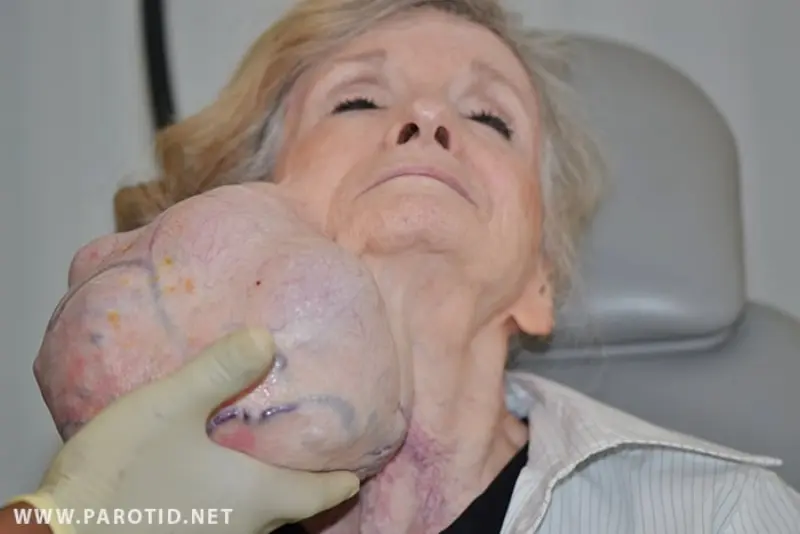
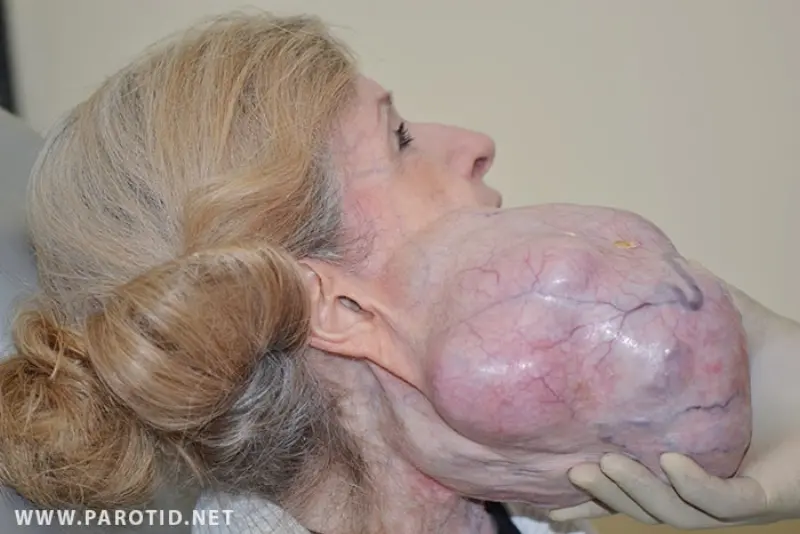
This case study describes the surgical treatment of M.G., a woman from New Jersey who lived for decades with a progressively enlarging parotid-region tumor that ultimately became so massive that she concealed it beneath her hair and withdrew from much of her social life. By the time she presented to Osborne Head & Neck Institute, the tumor extended from the region behind her ear below the jawline and into the neck. Prominent blood vessels traversed its surface, and its extraordinary size created significant concerns regarding surgical removal, facial nerve preservation, blood loss, reconstruction, and postoperative facial function.
Following extensive surgical resection and reconstruction, the tumor was completely removed while facial movement was preserved. Years later, M.G. described the result simply: she had gotten her life back.
Her case demonstrates that successful parotidectomy is not measured solely by removing a tumor. The ultimate objective is to remove disease safely while preserving facial function, restoring form, and returning the patient to the life that existed before the tumor took it away.
Background
Introduction
Tumors of the parotid gland represent the majority of salivary gland neoplasms, and most parotid tumors are benign.¹ Despite their frequently benign pathology, these tumors can create substantial surgical challenges because of the intimate anatomical relationship between the parotid gland and the facial nerve.
The facial nerve exits the skull through the stylomastoid foramen, enters the parotid gland, and divides into multiple branches responsible for movement of the forehead, eyelids, cheeks, lips, and lower face. Consequently, parotid surgery requires balancing adequate tumor removal against preservation of facial nerve function.¹˒²
Tumor size, location, depth, previous surgery, surrounding scar tissue, and the relationship between the tumor and facial nerve can substantially increase operative complexity. Larger and deeper tumors generally require more extensive dissection and can increase the risk of temporary or permanent postoperative facial weakness.²⁻⁴
M.G.'s tumor represented the extreme end of this spectrum.
I have operated on parotid tumors throughout my career and have managed extraordinarily complex head and neck disease in the United States and internationally. M.G.'s tumor was different. It was one of those cases that a surgeon never forgets.
Presentation
Patient History
M.G., also known as Lynn, lived in Bogota, New Jersey. Her story began many years before she arrived at Osborne Head & Neck Institute.
She first noticed an abnormality while attending a barbecue. Reaching behind her ear, she discovered a small lump. Something about it immediately concerned her. The mass did not disappear. Instead, it continued to grow.
Over approximately the next decade, M.G. recalled that the tumor doubled in size. Eventually, it became impossible to ignore. But she learned how to hide it.
M.G. carefully styled and draped her hair over the mass, eventually becoming remarkably skilled at concealing something that had grown to extraordinary proportions. Before leaving her home or receiving visitors, she could spend two and a half to three hours washing, drying, setting, and positioning her hair around the tumor. She described sometimes even gluing her hair into position so the mass remained covered.
What began as an anatomical problem gradually became a psychological and social prison. She became increasingly uncomfortable around strangers. People stared. Some asked questions. Others made insensitive comments. Eventually, avoiding those encounters became easier than enduring them.
Family gatherings became difficult. Rather than socialize, M.G. would sometimes remain in the kitchen washing dishes simply to avoid being seen. Over time, she withdrew further from public life. The tumor had not simply changed her appearance. It had changed how she lived.
Consultation
Finding Osborne Head & Neck Institute
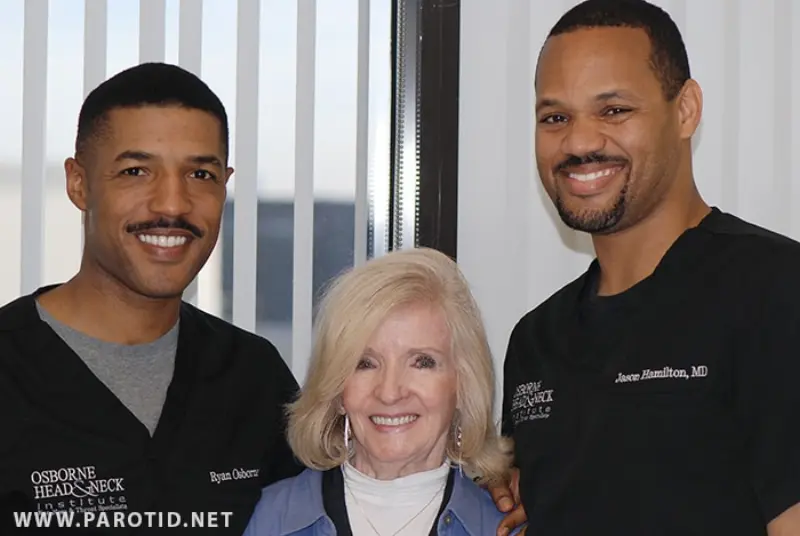
M.G.'s daughter, Sandra, recognized that her mother could not continue living this way. Sandra discovered Osborne Head & Neck Institute and arranged a consultation despite M.G.'s reluctance.
When Sandra initially contacted our office, she described her mother's condition very simply: her mother had a "football sized tumor." Even with that description, I was not prepared for what I eventually saw.
When M.G. first entered the consultation room, the tumor was almost completely concealed beneath her hair. For much of our conversation, I could not fully appreciate the extent of the disease. She was frightened, withdrawn, and understandably hesitant.
Eventually, after approximately half an hour, she moved her hair and exposed the mass. I remember that moment clearly. This was not a typical large parotid tumor. It was enormous.
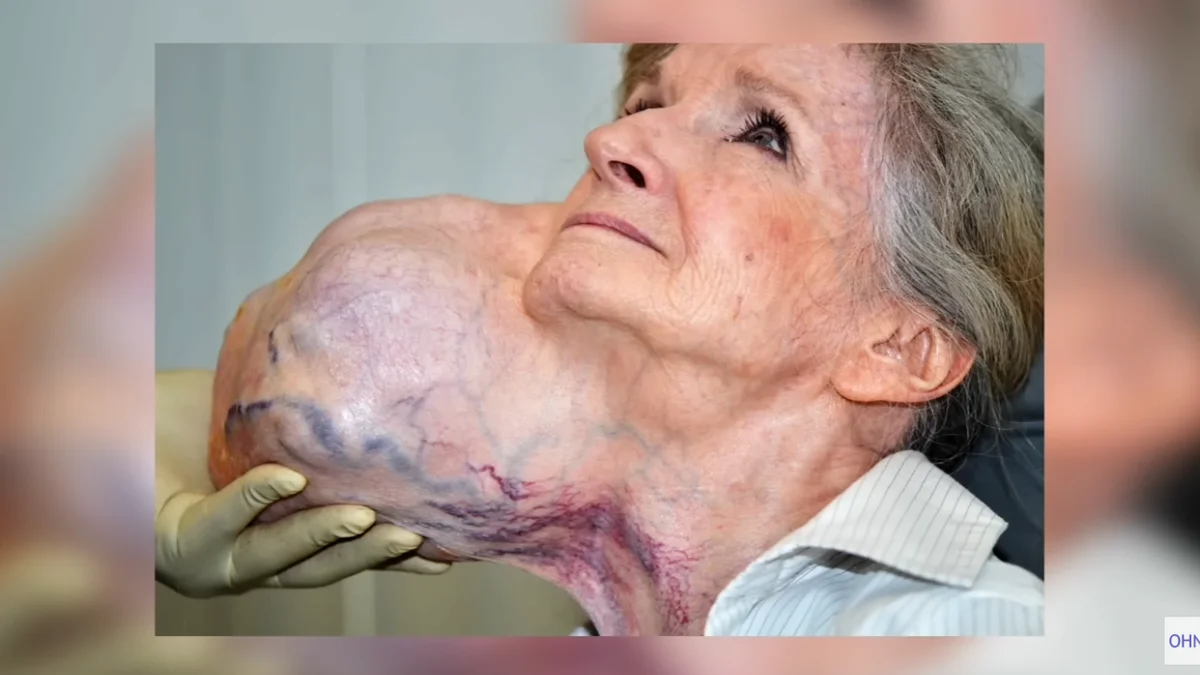
The tumor had progressed to the point that it appeared almost like a second head attached to the side of her face and upper neck. It extended below the jawline and into the neck. Large superficial blood vessels coursed across its surface. In decades of surgical training and experience, I had never encountered a parotid-region tumor of this magnitude.
Evaluation
Clinical Evaluation
Parotid tumors create a particular challenge because the facial nerve travels directly through the operative field. The fundamental objective of surgery is not simply to remove the mass. When oncologically appropriate, the surgeon must remove the tumor while protecting facial nerve function and minimizing complications and postoperative deformity.¹˒²
For localized benign tumors, contemporary surgical approaches can produce low recurrence rates with relatively low rates of permanent facial nerve morbidity.² However, the situation changes considerably as tumors become larger, extend deeper into the gland, or distort the normal anatomy surrounding the facial nerve. Studies of parotidectomy outcomes have demonstrated that tumor location and the extent of surgical dissection significantly influence postoperative facial nerve dysfunction.³˒⁴
M.G.'s anatomy was profoundly distorted. This was no longer a matter of performing a routine parotidectomy around familiar anatomical landmarks. The tumor had reached an extraordinary size and had developed extensive superficial vascularity. The surgical team needed to consider several major objectives simultaneously:
- Complete and controlled removal of the tumor
- Identification and preservation of the facial nerve and its branches
- Management of the extensive vascular supply associated with the mass
- Protection of surrounding head and neck structures
- Reconstruction of the substantial soft-tissue defect that would remain after removal
- Restoration of facial symmetry and contour
- Preservation of normal facial movement
Facial nerve injury is among the most important potential complications of parotidectomy. Published studies demonstrate that temporary facial weakness is considerably more common than permanent paralysis, with risk influenced by tumor location, depth, operative complexity, and extent of dissection.³⁻⁵ For M.G., preservation of facial movement was therefore one of the defining objectives of surgery.
Planning
The Decision to Operate
There are moments in a surgical career when the question is not whether an operation is technically possible. The question becomes whether you are willing to accept responsibility for attempting it.
M.G.'s case carried significant risk. Her tumor was massive. The normal anatomy had been altered. The facial nerve had to be protected. The vascularity of the tumor created additional concerns. Reconstruction would be necessary after removal.
There was also M.G. herself. She had lived with the tumor for so long that surgery was understandably terrifying. By the time she reached us, years of difficult interactions and unsuccessful attempts to find help had eroded much of her confidence in the medical system.
Yet there was another risk that had to be considered: doing nothing. The tumor had already taken decades from her. M.G. had become withdrawn and reclusive. She had reorganized her life around hiding the mass. She avoided people, social activities, and even walking through her own front door.
I had to consider not only the risk of surgery but also the consequences of leaving her exactly where she was. Ultimately, M.G. chose to proceed.
Operative Course
Surgical Management
We reserved the entire operative day for M.G.. A routine parotidectomy might occupy only part of a surgical day. For this operation, nothing else was scheduled. The entire surgical team was dedicated to her case.
The procedure required meticulous dissection around an enormous tumor whose size had significantly altered the normal surgical anatomy. Parotid surgery demands precise management of the tumor-facial nerve interface. The relationship between the tumor and facial nerve represents one of the most technically sensitive aspects of benign parotid surgery because inadequate tumor removal can increase recurrence risk while excessive manipulation can increase facial nerve morbidity.¹˒²
Published evidence also demonstrates that the likelihood of postoperative facial weakness rises as the extent and complexity of parotid surgery increase.³⁻⁵ In M.G.'s case, those principles were magnified by the extraordinary dimensions of the tumor.
The operation was long and intense. Eventually, the mass was completely freed and removed. It was so large that the usual specimen container used for surgical pathology was inadequate. We needed a specimen bucket. But removing the tumor was only the first part of the operation.
Reconstruction
Reconstruction After Massive Parotid Tumor Removal
A tumor occupying such a substantial portion of the lateral face and neck leaves behind a correspondingly significant defect. Once the tumor had been removed, we immediately turned our attention to reconstruction.
The objective was not simply to close the incision. We needed to restore facial contour and soft-tissue relationships as much as possible so that M.G. would awaken not only without the tumor, but with a face that looked and functioned naturally.
Reconstruction following parotidectomy is an important component of comprehensive parotid surgery. Loss of parotid tissue can produce facial contour abnormalities, asymmetry, and other functional or cosmetic consequences.¹˒⁶ For M.G., reconstruction was especially important because of the enormous volume occupied by the tumor before surgery.
When reconstruction was complete, the transformation was dramatic. But for me, the operation still wasn't finished. There was one question left. Would her face move?
Functional Outcome
Facial Nerve Preservation
The facial nerve is central to parotid surgery. Its branches control many of the movements that allow us to communicate emotion: smiling, closing the eyes, raising the eyebrows, moving the lips, and creating facial expression. Permanent facial paralysis can therefore have substantial functional, psychological, and social consequences.
The literature demonstrates why facial nerve preservation remains one of the primary measures of successful parotid surgery. In one large clinical series, postoperative weakness was strongly associated with the extent of surgery and tumors located deep to the facial nerve.⁴ Other reviews similarly identify facial nerve dysfunction as one of the principal complications surgeons must consider when selecting and performing parotid procedures.¹⁻³
After everything M.G. had endured, removing the tumor while leaving her with permanent facial paralysis would have represented an entirely different outcome. So after surgery, I waited for her to wake up. And then she smiled. Her face moved. That was the moment the operation felt complete.
Follow-Up
Postoperative Outcome
M.G. recovered successfully from surgery with preserved facial movement. The physical transformation was immediate, but the more important transformation occurred over the months and years that followed.
The woman who had once spent hours hiding her tumor beneath carefully positioned hair began going outside without fear. She traveled. She dressed beautifully. She spent time with her daughter. She participated in the world again.
At a later follow-up, she returned to the office almost unrecognizable from the frightened woman I had originally met. She was dressed beautifully, her hair was done, and she and her daughter had been traveling together.
"I got my life back."
That statement captures something that surgical statistics cannot.
Analysis
Discussion
A Slowly Growing Tumor Can Still Become Devastating
Many parotid tumors are benign.¹ Benign, however, does not mean harmless. A progressively enlarging mass can produce anatomical distortion, functional impairment, cosmetic deformity, psychological distress, and profound social isolation. M.G. lived with her tumor for decades. During that time, the disease progressively changed how she interacted with her family and the outside world.
Tumor Size Can Dramatically Increase Surgical Complexity
Small, localized superficial parotid tumors may sometimes be treated using limited surgical approaches.²˒⁶ Massive tumors are fundamentally different. As a tumor enlarges, normal anatomical relationships can become distorted, the facial nerve may be displaced or stretched, vascularity may increase, and reconstruction may become more demanding. Published evidence demonstrates that deeper tumors and more extensive operations are associated with greater rates of temporary facial nerve dysfunction.³˒⁴
Facial Nerve Preservation Is Fundamental to Successful Parotidectomy
The relationship between the facial nerve and parotid gland makes facial nerve management one of the defining technical components of parotid surgery.¹˒² For appropriately selected tumors in which the nerve is not directly invaded by malignancy, preservation of facial nerve function should remain a central surgical objective. Large surgical series demonstrate that facial nerve preservation can be achieved even during extensive parotidectomy, although operative complexity and tumor characteristics influence risk.³⁻⁵
Reconstruction Matters
Successful parotid surgery does not end when the tumor leaves the operating room. Removing significant volumes of parotid and surrounding tissue can create facial contour deformity and asymmetry.¹˒⁶ For patients with exceptionally large tumors, reconstructive planning becomes particularly important. Restoring soft-tissue volume and facial contour is part of returning the patient to normal life.
Surgical Success Must Be Defined From the Patient's Perspective
Surgeons naturally measure outcomes through tumor control, complications, facial nerve function, margins, and recurrence. Those measures matter. But M.G. changed the way I think about surgical success. Years after her operation, what mattered most was not that we had removed an enormous tumor. It was seeing what happened afterward. She traveled. She spent time with her family. She walked through her front door. She no longer needed to hide. The surgery succeeded because M.G. regained the life she wanted to live.
Summary
Conclusion
There are patients that remain with a surgeon throughout his career. M.G. is one of those patients for me.
When I first met her, I saw a woman who had spent decades adapting her entire existence around an enormous tumor. She had learned how to hide it physically, but the emotional and social consequences could not be hidden.
Her surgery required careful planning, an experienced surgical team, extensive tumor removal, meticulous facial nerve preservation, and reconstruction of the resulting defect. The tumor was successfully removed. Her facial movement was preserved. But those are only the technical results.
The real outcome was the woman I saw afterward. M.G. became active again. She traveled with her daughter. She returned to the world she had gradually withdrawn from over the preceding decades.
Parotid surgery is ultimately about more than removing disease. It is about preserving the face, protecting function, restoring confidence, and whenever possible, giving someone back the life their disease has taken away. M.G.'s case remains one of the clearest examples of that principle in my surgical career.
Watch the Full Story
Watch M.G.'s Journey
See M.G. describe her decades-long experience, the surgery that removed her massive parotid tumor, and the life she regained afterward.
References
- Larian B. "Parotidectomy for Benign Parotid Tumors." Otolaryngologic Clinics of North America. 2016;49(2):395-413.
- Borumandi F, George KS, Cascarini L, Gossiel F, McGurk M. "Parotid Surgery for Benign Tumours." Oral and Maxillofacial Surgery. 2012;16(3):285-290.
- Foresta E, Torroni A, Di Nardo F, et al. "Pleomorphic Adenoma and Benign Parotid Tumors: Extracapsular Dissection vs Superficial Parotidectomy, Review of Literature and Meta-analysis." Oral Surgery, Oral Medicine, Oral Pathology and Oral Radiology. 2014;117(6):663-676.
- O'Brien CJ. "Current Management of Benign Parotid Tumors, The Role of Limited Superficial Parotidectomy." Head & Neck. 2003;25(11):946-952.
- Guntinas-Lichius O, Klussmann JP, Wittekindt C, Stennert E. "Parotidectomy for Benign Parotid Disease at a University Teaching Hospital: Outcome of 963 Operations." Laryngoscope. 2006;116(4):534-540.
- Li C, Matthies L, Hou X, et al. "A Meta-analysis of the Pros and Cons of Partial Superficial Parotidectomy Versus Superficial Parotidectomy for the Treatment of Benign Parotid Neoplasms." Journal of Cranio-Maxillofacial Surgery. 2020;48(6):590-598.